Description of the Official Pilgrim Relic of Saint Carlo Acutis
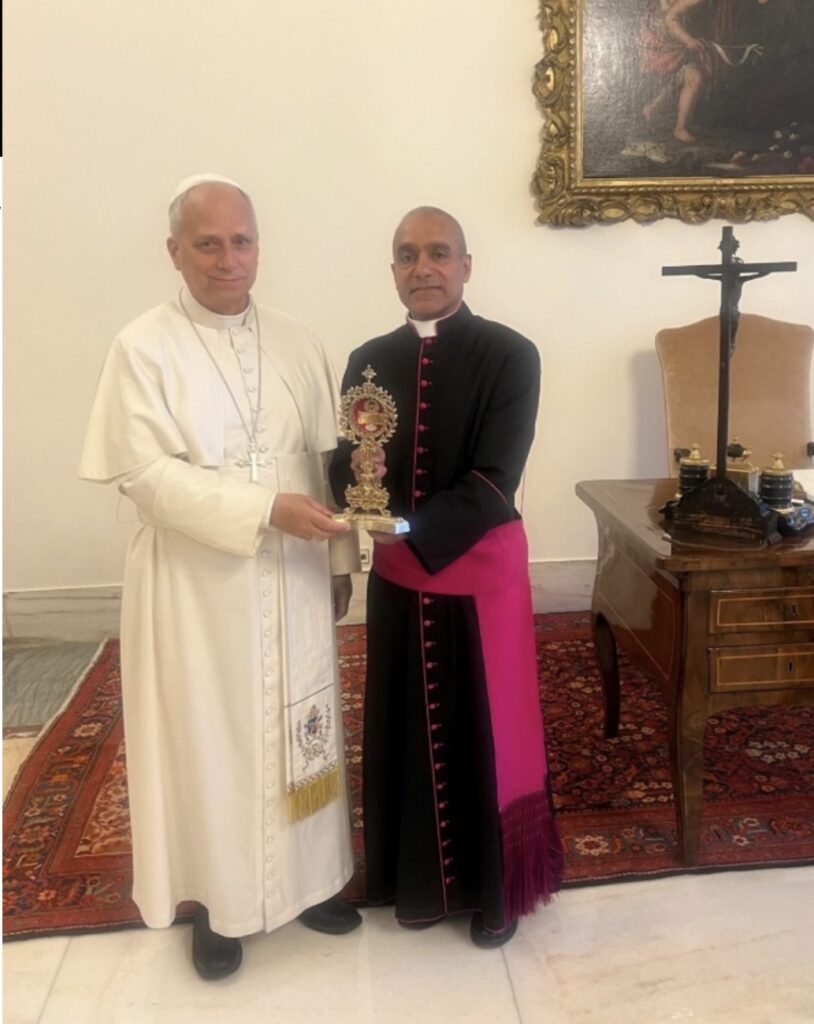
The First-Class pilgrim relic is 6 cm in length and 2 cm high and preserved in a reliquary 33 cm high and 17 cm wide. It is carried worldwide by the Diocese of Assisi, as sole custodian of the relics of Saint Carlo Acutis, and respecting Church guidelines on the pilgrimage of relics.
It is a section of the Saint’s pericardium, the membrane that surrounds the heart. This is a sac filled with water that encloses the heart and the great vessels, holding them in place and protecting the body’s most important organ. The relic, therefore, is of major importance physiologically.
The pericardium also contains deep spiritual meaning. The heart is the body’s most important organ; it is also the seat of our sentiments and actions. From the heart is born and lives our relationship with the Lord: “You shall love the Lord your God with all your heart” (Dt 6,5, Mt 22,37).
Moreover, when the side of Jesus was pierced on the Cross, “blood and water immediately flowed out” (Jn 19,34). Life giving blood, symbol of the Eucharist – to which Carlo Acutis was especially attached as his “highway to Heaven” – came from Christ’s Sacred Heart; water, the symbol of Baptism – “the basis of the whole Christian life” (Catechism of the Catholic Church, n. 1213) – likely came from the Lord’s pericardium.
Saint Carlo Acutis desired a living relationship with Jesus from a very young age. He wished to receive his First Holy Communion when only 7 years of age and on that day told his parents: “Always to be united to Jesus. This is my programme of life.” He protected and nurtured this most important of relationships with his “spiritual” pericardium of 5 practices or appointments: frequent reception of the Eucharistic Jesus, Adoration, spiritual direction and confession, devotion to the Blessed Mother and the saints, and acts of charity. It led him and can lead us to be saints, living just as he lived.
Concluding his homily to one million young people gathered in Rome for the Jubilee of Youth on 3 August 2025, Pope Leo XIV recommended specifically Saint Carlo’s “programme of life” and his 5 steps as the way to holiness:
“Jesus is our hope … Let us remain united to him, let us remain in his friendship, always, cultivating it through prayer, adoration, Eucharistic Communion, frequent Confession, and generous charity, following the examples of Blessed Piergiorgio Frassati and Blessed Carlo Acutis. Aspire to great things, to holiness, wherever you are. Do not settle for less. You will then see the light of the Gospel growing every day, in you and around you. I entrust you to the Virgin Mary, Our Lady of Hope.”
In St. Peter’s Square for the Mass and Canonization of Blessed Pier Giorgio Frassati and Carlo Acutis (7 September 2025), the Holy Father spoke again of the five steps to being a saint:
“Both Pier Giorgio and Carlo cultivated their love for God and for their brothers and sisters through simple acts, available to everyone: daily Mass, prayer, and especially Eucharistic Adoration. Carlo used to say: ‘In front of the sun, you get a tan. In front of the Eucharist, you become a saint!’ And again: ‘Sadness is looking at yourself; happiness is looking at God. Conversion is nothing more than shifting your gaze from below to above; a simple movement of the eyes is enough.’ Another essential practice for them was frequent Confession. Carlo wrote: ‘The only thing we really have to fear is sin’; and he marvelled because — in his own words — “people are so concerned with the beauty of their bodies and do not care about the beauty of their souls.” Finally, both had a great devotion to the saints and to the Virgin Mary, and they practiced charity generously. Pier Giorgio said: ‘Around the poor and the sick, I see a light that we do not have.’ He called charity ‘the foundation of our religion’ and, like Carlo, he practiced it above all through small, concrete gestures, often hidden, living what Pope Francis called ‘a holiness found in our next-door neighbors’ (Apostolic Exhortation Gaudete et Exsultate, 7).”